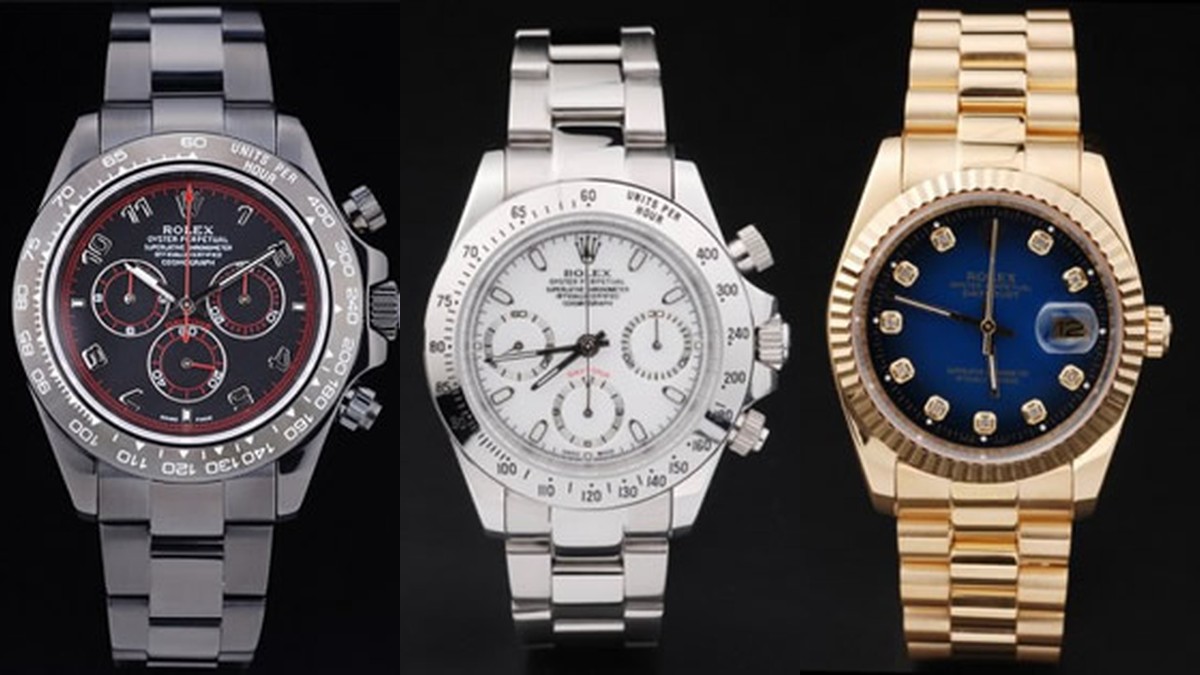
What the phrase “copy Rolex” actually covers
The phrase copy Rolex is used for watches that range from obvious low-cost imitations to mechanically complex replicas intended to reproduce a specific Rolex reference. The original version of this page divided the market into crude quartz copies, mid-range mechanical watches and expensive exact replicas. That hierarchy still describes the broad market, but the labels and old price ranges are too unreliable to use as quality proof today.
The useful question is not “what grade does the seller call it?” but “what exactly is being copied, and how closely?” A Submariner requires different checks from a Datejust. A Daytona requires a true chronograph architecture if its subdials and pushers are expected to work in the correct pattern. A Day-Date needs a movement and calendar module capable of presenting both indications in the right positions.
Three quality tiers, without the old price shortcuts
| Tier | Typical construction | Best use of the label |
|---|---|---|
| Entry level | Budget quartz or basic automatic movement, simplified case and bracelet | Expect obvious compromises and verify basic function |
| Mid tier | Established automatic movement, closer dimensions and better finishing | Compare model proportions and movement compatibility |
| High tier | More model-specific case, dial, bracelet and decorated/clone-style movement | Require individual QC because marketing labels become least reliable here |
Why the Deepsea and Submariner exposed weak copies
The Deepsea is a useful example of a specialist Rolex design because dive watches combine visual and functional claims. The bezel must align and rotate correctly, crown guards need the right shape, and the bracelet must feel secure. Most importantly, a replica cannot be assumed to share the genuine model’s depth rating simply because it uses a screw-down crown.
For current Submariner reference 124060, Rolex specifies a 41 mm Oystersteel case, calibre 3230, a unidirectional 60-minute Cerachrom bezel and a 300 m genuine water-resistance rating. Those specifications are a reference point only. A replica should be pressure tested individually if it will be exposed to water. See the Submariner guide for a model-specific checklist.
Movement quality is about suitability, not nationality alone
Swiss movements have a strong reputation for good reason, but “Swiss” is not a complete quality description. A well-established Japanese movement may be easier to service than an obscure decorated movement marketed as a clone. Conversely, a genuine Swiss calibre can be a very good choice in a simple watch even if it does not reproduce Rolex architecture.
The movement must also suit the visible functions. A date-only calibre can work well in a Datejust-style watch. A Day-Date needs day and date capability or an added module. A Daytona needs chronograph architecture that produces the expected subdial layout. This is why our technical guides separate Swiss movement claims from Japanese movement options instead of ranking them with one word.
Materials: where marketing can outrun evidence
Terms such as 904L steel, sapphire crystal, ceramic bezel and gold plating describe real material differences, but not all can be proven from a photograph. Surface color and polish can be judged visually; steel grade generally cannot. A sapphire crystal can sometimes be supported by tester results, while water resistance requires pressure testing. Gold-colored parts may use different plating or coating systems with very different wear characteristics.
The practical approach is to separate visible finish from material composition. A watch can look excellent while using a different alloy from the genuine model. That distinction does not make the visual comparison meaningless—it simply keeps claims accurate. The materials guide explains which claims can be checked and which need evidence beyond photographs.
Rolex history: from Wilsdorf & Davis to recognizable model families
Hans Wilsdorf and Alfred Davis began the business in London in 1905, and the Rolex name was registered in 1908. The company later moved its center of operations to Geneva. Over time the Oyster case, automatic winding and chronometer performance became central to the brand’s identity. The Datejust, Submariner, Daytona and Day-Date then developed their own visual languages.
For replica evaluation, history matters most when it helps identify the correct generation. A Datejust from one era should not be judged by the case proportions of another. An older five-digit Submariner and a current 41 mm Submariner do not use the same bezel, bracelet or case geometry. “Rolex style” is too broad; reference-specific comparison is more useful.
A six-part quality check for any Rolex copy
That six-part framework is more dependable than the old $50/$200/$1,000 hierarchy because it still works when market prices change.
Model generation is the first filter for every copy
Many weak comparisons happen because the watch is matched against the wrong generation. A five-digit Submariner does not share the same case and bezel details as a current six-digit model. Older Datejust references differ from current 36/41 mm watches in bracelet, case and movement details. Daytona generations change bezel material, subdial design and movement architecture. Before zooming in on a coronet or date font, identify the era and reference family.
This is especially important for replica sellers that use a familiar model name without a specific reference. If the product combines a current ceramic bezel with older case geometry, it may look generically “Rolex-like” while not accurately copying any real configuration. A good copy should be internally consistent, not simply packed with recognizable features.
What “exact copy” misses about wear and service
Visual similarity at delivery is only one part of quality. Bracelet screws, crown tubes, movement parts, coatings and clasp components wear over time. A watch built around a documented movement can be easier to maintain than a highly decorated but obscure calibre. Likewise, a gold-colored coating that looks excellent when new may become the defining weakness after months of abrasion at the clasp and bracelet edges.
For that reason, long-term value should include serviceability and finish durability. Ask whether the movement is replaceable, whether common gaskets fit, whether bracelet links can be sourced, and how the seller handles coating wear or movement failure. These questions are less glamorous than macro photos but more relevant after the first few weeks of ownership.
How to compare two replicas of the same model
When choosing between two versions, keep the comparison fixed to the same reference and configuration. Use the same categories—case, dial, bezel, bracelet, movement, functions, QC—rather than allowing each seller to frame the comparison around its strongest feature. One seller may emphasize “Swiss movement,” another “904L,” and a third “super clone.” A standardized checklist turns different marketing languages into comparable evidence.
Record unresolved claims rather than assuming the higher-priced option wins. If one watch has a documented movement but unknown steel grade, and another claims 904L but will not disclose the movement, the uncertainty belongs in the comparison.