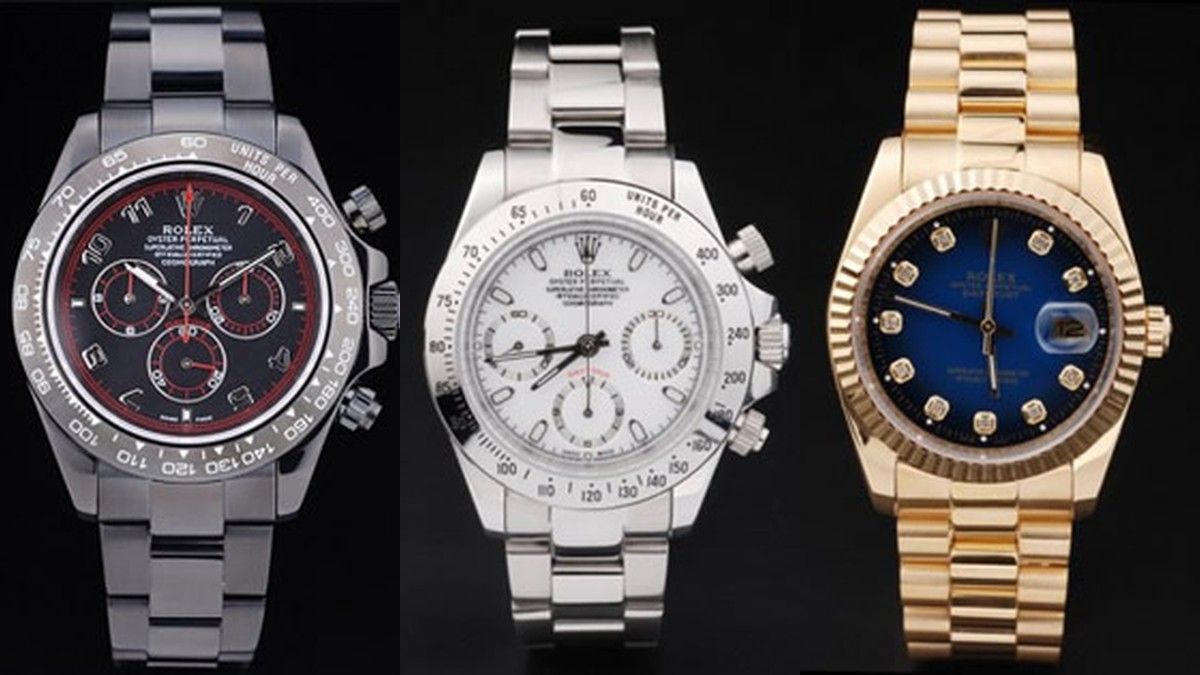
The practical side of Japanese movements
Japanese automatic movements are common in affordable and mid-tier watches because they can provide reliable timekeeping without the cost or sourcing uncertainty associated with some Swiss movements. The problem is that sellers sometimes reduce all of them to one phrase—“Japanese Miyota”—even though different calibres have different dimensions, beat rates and functions.
Two useful examples are MIYOTA 8215 and 9015. Both are established automatic date movements, but they are not interchangeable in terms of height or beat rate.
8215: old-school, robust, unmistakable
MIYOTA lists calibre 8215 as an 11½-ligne automatic movement, 5.67 mm high, with 21,600 vibrations per hour and approximately 42 hours of running time. It provides three hands and date, automatic and hand winding, quick date setting and stop seconds on the current specification.
Its 5.67 mm height matters when fitting it into a replica case. If the target Rolex reference is thin, case or hand-stack compromises may be needed. The 21,600-vph frequency also differs from the 28,800-vph movement behavior often associated with many modern Swiss calibres.
9015: thinner, faster, more flexible
MIYOTA’s 9015 is approximately 3.90 mm high, uses 24 jewels, runs at 28,800 vibrations per hour and provides a date display with roughly 42 hours of running time. Those specifications can make it attractive where case thickness and a higher beat rate matter.
It is still a date-only architecture. A listing that claims a standard 9015 directly provides a full Day-Date display should explain the additional calendar mechanism. Likewise, using a 9015 does not make a watch a “Rolex clone”; it makes the movement choice a practical Japanese alternative.
Where each calibre fits naturally
| Model type | 8215/9015 suitability | Main caveat |
|---|---|---|
| Oyster Perpetual-style | Good for simple three-hand layouts | Date-only calibres require date omission or modification |
| Datejust-style | Good where date placement and stem height are engineered correctly | Calendar font/magnification remain separate QC issues |
| Submariner Date-style | Mechanically practical | Case thickness and date position must match |
| Day-Date-style | Not direct without day functionality/module | Calendar module can affect height and crown positions |
| Daytona-style | Not a Daytona chronograph solution | No native chronograph architecture |
Serviceability is a feature, not a compromise
An established movement with clear manufacturer documentation has an advantage: a watchmaker can identify what it is. That does not guarantee every repair is economical, but it is better than a movement whose only identity is a seller-created clone name. For a closed-caseback watch, practical serviceability may offer more long-term value than decorative bridges hidden from view.
A movement check that takes five minutes
- Confirm the exact MIYOTA calibre.
- Check whether the listing’s beat-rate claim matches manufacturer specifications.
- Confirm whether the watch uses date only, day/date or an added calendar module.
- Check case thickness and crown position for signs of poor movement integration.
- Measure power reserve if it is important to you.
- Use a timegrapher as a diagnostic tool, not as proof that the entire watch is high quality.
8215 and 9015 are not just “cheap versus premium”
The 8215 is thicker and lower beat; the 9015 is thinner and higher beat. That difference affects case design and seconds-hand appearance, but neither automatically determines the quality of the finished watch. A well-integrated 8215 can be preferable to a poorly cased 9015. The movement must be judged inside the target model.
Calendar overlays can change what the movement looks like from the dial
A base date wheel may not place numerals exactly where a replica dial requires them, so manufacturers sometimes use overlays. This can alter font, vertical position and the force required to change date. If a Datejust replica uses a Japanese movement, inspect multiple date values because an overlay can sit differently around the wheel.
Rotor noise and winding feel
Japanese movements have characteristic winding behaviors. Buyers sometimes interpret rotor sound as a defect when it is normal for the calibre, while truly rough winding can indicate poor installation or damage. Compare behavior with the known movement rather than with a Rolex calibre it was never designed to imitate.
Regulation and realistic accuracy targets
MIYOTA publishes broad factory accuracy ranges for standard movements. A seller can often regulate an individual movement more closely, but a single favorable timegrapher screenshot does not permanently change the manufacturer specification. Observe the watch over several positions and, after delivery, over several days.
Why a Japanese movement can be the rational choice
For buyers who prioritize reliable operation, easy identification and replacement availability, an established Japanese calibre can make sense. It is less appropriate when the goal is internal architectural similarity to Rolex or when the watch requires a complication the base movement does not provide.
Thickness is especially important when comparing 8215 and 9015. The 8215’s 5.67 mm height gives case designers less vertical room than the 9015’s 3.90 mm height. In a watch where slim case profile matters, this difference can influence caseback shape, hand clearance and crown alignment. That is a mechanical reason to prefer one calibre in a specific case, not simply a hierarchy of prestige.
The lower 21,600-vph frequency of the 8215 also produces a different seconds-hand cadence from the 9015 at 28,800 vph. Buyers who care about visual smoothness may prefer the higher beat, while buyers focused on basic robustness may not consider the difference decisive. Neither frequency should be described as matching Rolex by default; compare the intended reference and the installed movement honestly.
If a seller advertises a Japanese movement under a decorated plate, ask whether normal service access is preserved. Cosmetic covers can complicate diagnosis or removal. A movement’s strongest advantage—easy identification and replacement—can be reduced if decorative modifications make it harder for a watchmaker to reach ordinary components.
For QC, let the watch run for a meaningful period after full winding. Check date change, restart after resting, and whether the automatic winding system actually restores reserve during wear. These simple ownership tests tell you more than the country label alone.