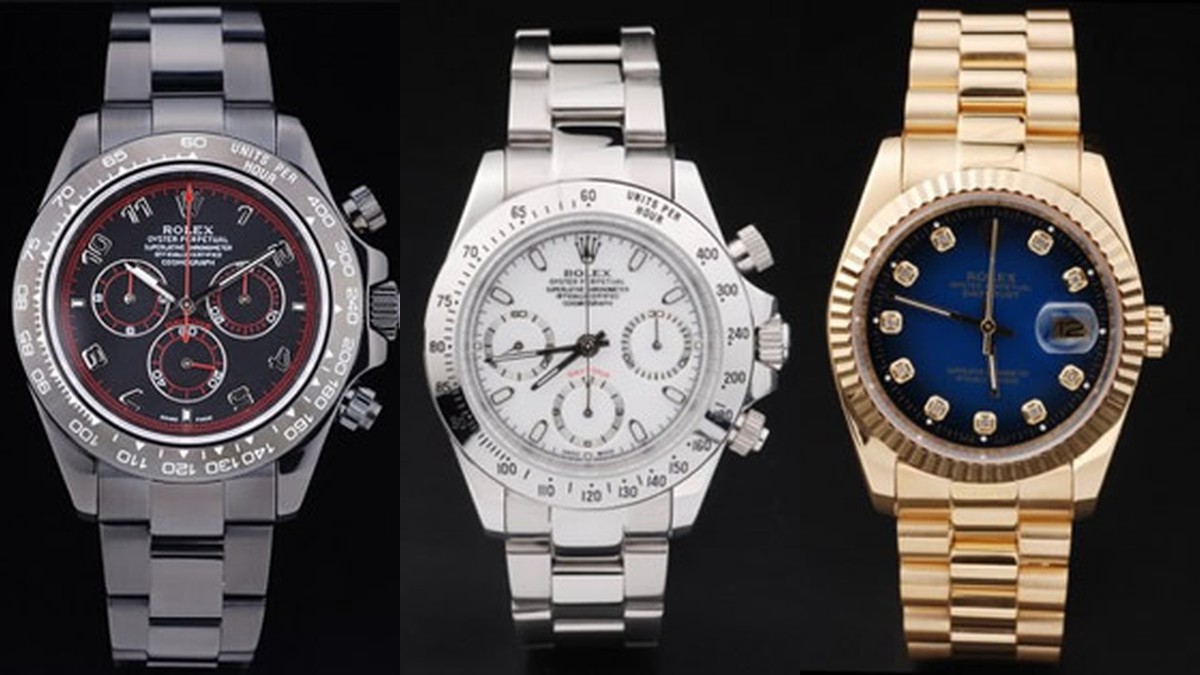
The label is the least interesting part
The original SwissRolexCopies.com was built around a simple idea: higher-tier Rolex copies were often marketed as “Swiss made” because the movement was treated as the main sign of quality. That was a useful shorthand years ago, but it is too imprecise for the current replica market. A seller can use the words Swiss movement, AAA+, 1:1 or super clone without those terms describing the same construction from one watch to another.
A better way to compare replica Rolex watches is to begin with the model being copied. A Daytona has chronograph-specific problems. A Datejust exposes mistakes in the Cyclops, date window, bezel and bracelet. A Submariner is unforgiving around the crown guards, ceramic bezel and bracelet. A Lady-Datejust 28 compresses all of those details into a much smaller case. Movement choice matters, but it is only one part of a watch that must work as a whole.
Check case size, thickness, bezel, dial layout, bracelet and visible functions against the intended reference.
Identify what is actually installed rather than treating “Swiss” or “clone” as proof.
Use photos, video and function checks from the watch being shipped, not only catalogue images.
Daytona is where shortcuts show first
The old homepage focused heavily on the Cosmograph Daytona, and that remains a sensible choice. The Daytona is not simply a three-hand watch with decorative subdials. On the current genuine reference 126500LN, Rolex uses calibre 4131, with central chronograph seconds, a 30-minute counter at 3 o’clock, a 12-hour counter at 9 o’clock and small seconds at 6. The case is 40 mm, with a ceramic tachymeter bezel and 100 m water-resistance rating on the genuine watch.
Those details explain why Daytona replicas need more scrutiny. A movement with a different chronograph architecture can push subdials into the wrong positions or increase total thickness. Decorative subdials can look convincing in still photographs while not operating correctly. Pusher feel, reset-to-zero behavior and hand alignment therefore matter more than a rotor engraving. The Daytona file follows that problem from the subdials inward, where movement architecture starts to dictate everything visible above it.
Datejust rewards proportion rather than drama
The Datejust works for the opposite reason. Its appeal is easier to understand: a classic dial, date window, Cyclops lens and a choice of Oyster or Jubilee bracelet make it instantly recognizable. That apparent simplicity makes proportion errors more obvious. A weak Datejust copy often gives itself away through the date position, magnification, rehaut alignment, bezel shape, bracelet end links or the relationship between the dial and case.
The Lady-Datejust 28 requires even more attention because the smaller case leaves less visual room for error. The genuine Lady-Datejust 28 uses calibre 2236, a 28 mm Oyster case and 100 m water resistance on current references. Replica versions may use entirely different movements and should not inherit those genuine specifications by assumption. The useful comparison is whether the replica’s case, dial, date mechanism and bracelet reproduce the correct visual proportions while operating reliably.
Inside the case: the movement question
Older replica-watch advertising often presented Swiss ETA as the dividing line between ordinary copies and premium copies. Today that claim needs verification. Genuine Swiss movements, Asian movements designed around Swiss dimensions, decorated movements and movements marketed as clone calibres can all appear under similar sales language. A photograph of an engraved rotor is not enough to identify the underlying calibre.
When a seller claims a Swiss movement, ask for the exact calibre and then check whether its functions suit the watch. A simple three-hand Datejust-style watch has different requirements from a Daytona chronograph or a Day-Date with two calendar indications. Our Swiss movement guide explains what to check, while the Japanese movement guide covers practical alternatives such as MIYOTA 8215 and 9015.
Three tiers, no universal standard
Three broad quality tiers are still useful as a starting point—entry-level, mid-tier mechanical and higher-detail builds—but old fixed price bands are no longer reliable. Instead of assigning quality from price alone, use a scorecard built around what can actually be inspected.
| Area | What matters | Common weak point |
|---|---|---|
| Case | Diameter, thickness, lug and crown geometry | Wrong profile even when diameter is correct |
| Dial | Printing, marker placement, hand length, calendar alignment | Good macro photo but poor overall spacing |
| Bezel | Shape, engraving, insert alignment and action | Incorrect font or rotation feel |
| Bracelet | Taper, end-link fit, articulation and clasp | Sharp edges or loose end links |
| Movement | Real calibre, functions, beat rate and serviceability | Marketing name does not match architecture |
| Water resistance | Individual pressure-test result | Assumed from a screw-down crown |
A short history worth keeping
The original pages also contained a short history of Rolex. Hans Wilsdorf and Alfred Davis founded the business in London in 1905, and the Rolex name was registered in 1908. The brand later became closely associated with the Oyster case, automatic winding and chronometer-certified wristwatches. This history matters because many of today’s recognizable model features developed from that engineering and design language.
It should not be used, however, to imply that a replica shares Rolex’s testing, certification or materials. Genuine specifications are best treated as a reference target: they tell us what the design is supposed to be. Replica quality must then be judged independently.
Five model files, five different problem sets
Chronograph layout, pushers, subdials, case thickness and movement architecture.
DatejustCyclops, date, Jubilee/Oyster bracelets, bezel and current 36/41 proportions.
Lady-Datejust 28Small-case proportions, calibre claims, diamonds, dial and bracelet finishing.
SubmarinerBezel, crown guards, Oyster bracelet, lume and pressure-test evidence.
Day-DateDay/date alignment, President-style bracelet and calendar movement compatibility.
QC checklistA practical pre-shipment check that works across the model families above.
Before money changes hands
- Confirm the exact model and size being offered.
- Ask for photos or video of the individual watch whenever possible.
- Verify the movement by calibre and function rather than by marketing tier.
- Check date, chronograph or day/date complications through a full setting cycle.
- Review return, replacement and shipping terms in writing.
- Treat water resistance as a test result, not a promise based on appearance.
This approach is less dramatic than claims such as “impossible to tell” or “exactly the same as genuine,” but it is more useful. A good replica-watch guide should help a reader identify what is known, what is merely advertised and what still needs evidence.
Read a listing from the outside inward
Replica listings often compress several different claims into one sentence: “Swiss made,” “904L,” “sapphire,” “1:1,” “waterproof,” and “clone movement.” Treat each one as a separate line item. Some can be checked immediately, some need a function video or measurement, and some cannot be confirmed without testing. This matters because a watch can be strong in one area and weak in another. A well-machined case does not prove the movement; a reliable movement does not correct an inaccurate dial.
A useful comparison therefore moves from the outside inward. First confirm the model and proportions. Then inspect the dial, bezel and bracelet. After that, verify the movement and complications. Finish with tests that apply to the individual watch, especially pressure resistance. This order mirrors what a buyer can actually observe rather than the order in which a seller presents marketing claims.